FIFA Soccer Ball Testing and Approvals
FIFA APPROVED LOGO
FIFA INSPECTED LOGO
The above logo’s are printed on all soccer balls that are either FIFA Approved or FIFA INSPECTED. Only the highest of quality balls can pass the testing requirements.
FIFA Denominations Programme
The testing procedures and designations offer many benefits to those who buy soccer balls (footballs) including guaranteed quality, value for money and better playing performance. Since January 1, 1996 only those outdoor footballs which have been tested and meet the demanding quality criteria, bearing either of the official markings ‘FIFA Approved‘, ‘FIFA Inspected‘ or ‘International Matchball Standard (IMS),’ are allowed to be used in FIFA (Fédération Internationale de Football Association www.fifa.com ) competition matches and competition matches under the auspices of the six continental Confederations.
As of January 1, 2000 the quality testing and certification has also become compulsory for indoor footballs used for international matches under the auspices of FIFA and the Confederations.
FIFA has set out to ensure that the balls used in top matches meet the most exacting standards. It has meant a general upgrading of standards of footballs (soccer balls) throughout the world.
Testing procedures for the balls submitted for these designations are designed to simulate match conditions. Manufacturers have to submit seven balls if they are applying for “FIFA Inspected” status, and ten samples if they seek the “FIFA Approved” label. All these are put through their paces at EMPA, the Swiss Federal Laboratories for Materials Testing and Research in St.Gallen.
There is another qualification level, too, less demanding than the others. This is the designation “International Matchball Standard”, and for this the applicant footballs (soccer balls) can be sent to any of seven European test institutes which have been selected by FIFA to test and certify the balls for this category, which is free of any royalty fees.
There are a total of seven tests. All footballs are submitted for the first six and only potential “FIFA Approved” candidates for the seventh test, which is a shooting test for shape and size retention, including change of pressure.
However, the criteria for “FIFA Approved” footballs are higher throughout. For example, 25% loss of pressure is acceptable for a “FIFA Inspected” applicant, but only 20% for a “FIFA Approved” ball.
Video:
Testing The Euro Ball
Testing:
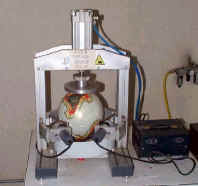
- Circumference: The first test – for circumference – requires the first three footballs to be conditioned for at least 24 hours. They are then inflated to a defined pressure and the diameter of the ball is measured in ten exactly defined points. The test is designed to ensure a well-balanced response in play.
- Sphericity: The second test is for sphericity, which ensures the ball’s in-flight stability. The apparatus used is the same as that used for determining the circumference. The conditioned balls are inflated to a test pressure of 1.0 bar and the diameter of the ball is measured at the middle of the 16 panels, with a high degree of accuracy. The difference between the highest and lowest diameter is determined as a percentage of the mean diameter. The mean difference in the highest and lowest diameter of the three footballs in recorded in the test report.
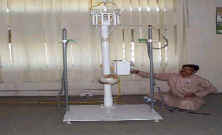
- Rebound: This is important too, to make sure that the ball bounces in a predictable manner, vital in top class matches. The football is dropped, in guided free fall and with a defined velocity, onto a steel surface. With the help of a video camera, the height of rebound at the lower side of the ball can be determined.
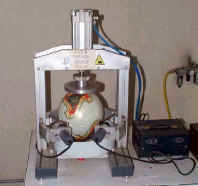
- Water absorption: It is important that a football does not become too heavy when wet. The conditioned footballs are placed in a receptacle filled with 2 cm of water. After being compressed a number of times, with a pneumatic position to simulate playing conditions, the ball is removed, wiped dry and reweighed. Its increase in weight is expressed as a percent of the original weight of the ball, defining precisely the amount of water that has been absorbed.
- Weight: Weight is vital, because it ensures a consistent playing response when the ball is struck. Football samples are inflated and weighed in a standard atmosphere, with a wind protected electronic balance. The mean weight as well as the single values of the three fallouts are recorded in the report.
- Loss of Pressure: The football should not lose pressure over time, thereby remaining playable. The balls are inflated to a defined pressure, then left in a standard atmosphere for a certain period of time, after which the pressure is measured again.
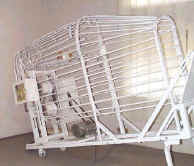
- Shape and Size Retention (“FIFA Approved” only): This test is designed to ensure that the footballs last, even in the most challenging situations. The footballs are inflated to a defined pressure. Two rotating cylinders accelerate the balls to a specific velocity, so that they hit a steel panel at a consistent speed and angle. The footballs are examined after 2000 shots and the increase in circumference and deviations on sphericity are measured. The testing procedures and designations offer many benefits to those who buy footballs including guaranteed quality, value for money and better playing performance.
Detailed FIFA test requirements
Referees of FIFA and Confederation matches are among the beneficiaries. They simply have to check that the ball carries one of the three marks and that the pressure is correct, rather than having to check weight, circumference and other details before matches.
The testing criteria are indeed tough, but they have been set by the industry itself. Only the best products pass the test, which means that the new standards are worthwhile. Licensees include most of the major leading brands and also manufacturers from India, China, Thailand and Japan, showing that the value put on the FIFA mark is as universal as football itself.
What Players think of the Modern Ball
We look at the effect the Programme has had on the game itself. Has it improved skill levels? Has the job of match officials been made any easier – and have there been any medical benefits or all-round improvements? 10-Dec-1998
Information and articles graciously provided by FIFA. www.fifa.com